
Tazacorte
This is the smallest and most recently formed municipality of La Palma. It extends over 11.7 sq. km along the coast from the mouth of the Barranco de Las Angustias ravine to Las Hoyas, the place where the San Juan volcano spilled out increasing the size of the land in 1949. It borders with Tijarafe to the north at El Time, and with Los Llanos to the east through an arbitrary line.
The large beach at the port of Tazacorte was the place chosen by the Spanish to begin the conquest of La Palma around 1492.
The best lands were soon divided, as were rights to the water coming from the Caldera crater. Important estates were bought by the wealthy families of the capital city and by Flemish traders who saw a prosperous future in the sugar industry.
The country estates of Argual and Tazacorte, together with the sugar mills of the Monteverde, Vandale and Sotomayor families, to whom all the land and water belonged, soon became the economic motor of the island.
The port at Tazacorte was the second most important in the island after that of the capital, Santa Cruz. During the XVI century national and foreign ships stopped there to collect sugar, wine and other island products. Frequent visits from corsairs and pirates forced the owners of the estates to build small forts (no longer in existence) to protect their interests.
 Despite this economic drive, the majority of the people of Tazacorte lived in quite poor conditions in this neighbourhood of Los Llanos, mainly inhabited by farmers and fishermen. Cochineal and sugar revitalised the economy in the second half of the XIX century, but continued crises nonetheless accelerated emigration to America.
Bananas were not grown extensively until the end of the First World War, with the arrival of the English company, Fyffes Limited, and other companies. Wealth and businesses remained in the hands of a tiny percentage of the population and in Tazacorte at this time a handful of employers employed the rest of the population to do the work.
The struggle for independence or segregation from Los Llanos became heated at the beginning of the XX century. With 2,316 inhabitants in 1923, Tazacorte was the most populated area in the municipality of Los Llanos and the most economically developed area in Valle de Aridane.
The definitive battle for emancipation took place, as much in Madrid as in the island itself, during the dictatorship of Primo de Rivera. On OOOON16th September 1925, Tazacorte was granted independence by decree.
Three years later an epidemic broke out – the Plague of 1928 – a sorrowful time still remembered by the inhabitants.
Nowadays Tazacorte is striving to develop and maintain its fishing and trade port, banana production and tourism.
The fishing trade
 Tazacorte has traditionally been associated with the fishing industry. Ships sail from its port along the cliffs towards Fuencaliente or off into the distant horizon.
Fishermen, wise in their ways, fish when others sleep, attempting to escape the rough seas and high waves. Their tanned salty faces look patiently into the winds, discerning when storms are due and observing the movement of seagulls that indicate the whereabouts of their sought-after shoals. Their hands age as the years pass and they continue their hauling of ropes and nets as they go deep sea fishing with their armour of fishing equipment. With nobility and expertise they catch the fish which is later supplied to the market.
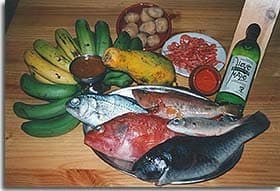
On the shore, the arrival of the boats is eagerly awaited and the fishermen proudly display their gifts of the sea, which include conger eels, parrot fish, trigger fish, cardinal fish, dogfish, morays, horse mackerel, and bream which wriggle about on the boat before being unloaded.
On the land, women, children and the elderly collect limpets and snails. With white cloths and a spike they capture octopus and at night-time they dazzle unsuspecting crabs with lights. Morays are attracted by chants and song, and the marine snakes are lured to their death by these human voices.
Such are the everyday occurrences in the traditional life of fishing folk whose future remains uncertain but hopeful.
Legendary episode of the MARTYRS OF TAZACORTE
Around the year 1570 a group of Jesuit missionaries set sail in seven ships from Lisbon for Brazil to spread the faith. The Santiago was taking merchandise to the island of Madeira, the island of La Palma and Brazil, stopping off in the port of Tazacorte perhaps to collect sugar. There Father Acevedo met an old school friend and descendent of the wealthy Monteverde family, who generously invited the group to his house where they stayed several days.
The religious man said mass in the San Miguel chapel. As legend goes, it was in this moment that he had a revelation of the martyrdom they were about to suffer. The emotional impact of this revelation caused his teeth to pierce the silver chalice. The chasuble worn by the holy man on that day is still preserved in the chapel.
On July 13th the ship set sail in the direction of Santa Cruz de La Palma, however failing winds left them stranded off the coast of Fuencaliente until the 15th when they were attacked by five French Huguenot ships. After a hard battle the crew of the Santiago were finally subdued. The missionaries were tortured, mutilated and cruelly murdered. However, Father Acevedo inspired his companions to die with faith in defending the sacred Church. The corpses were thrown overboard into the sea. Forty crosses now rest at the bottom of the ocean in the place where the sad episode of the Martyrs of Tazacorte took place.
FESTIVITIES
In the locality affectionately called París chiquito or little Paris, people celebrate festive events with true passion. The people in Tazacorte are liberal, progressive, tolerant, great lovers of music and have a creative spirit.
Amongst the most important celebrations are those of July 16th, when fishermen take Virgin of Carmen out to sea in a procession, and September 29th when the biggest celebrations in honour of Saint Michael Archangel, Patron Saint of the town and port of Tazacorte and of La Palma, take place.
People eagerly await the unique dance of the Caballos Fufos horses, to watch their cane bodies dressed in silk paper trot along the streets to the rhythm of the music. The horsemen try to break in their beasts which rear up, neigh and snort amongst the crowds.
SUGGESTIONS
A favourable climate, water resources and the persistence of its inhabitants have made this place one of the most prosperous agricultural areas in the island. Bananas are cultivated intensely, forming a great blanket of vegetation which spreads across the land right to the coast.
After taking a relaxed tour of the town we suggest a walk down to the fishing port where it is possible to buy some fresh fish or take a boat trip to the giant cave of Cueva Bonita under the cliffs of Tijarafe.
In the restaurants and bars of the area you can enjoy various seafood dishes – grilled, stewed or fried.
Recommended leisure activities include aquatic sports which can be practised all the year round, as well as cycling, caving, and hiking along the trackways of the coast (including climbing to El Time).
PLACES OF INTEREST
San Miguel Church
In the town we recommend the area around San Miguel church, constructed on the site where the island’s first chapel was built. Alonso Fernández de Lugo began the conquest of the island at Tazacorte in 1492 and his dedication to Saint Michael Archangel led the latter to be named Patron Saint of the island. He is represented in the coat of arms of La Palma wearing military uniform and holding a sword which protects the Church.
A quiet peaceful air surrounds this pioneering temple that became a parish church in 1922. The church houses the relics of the Jesuit martyrs and an interesting art collection.
The building is surrounded by a plaza and it has an Andalusian-style pergola with Seville tiles which supports a tangled bougainvillaea, which casts its shadow over the pathway.
Charming spots
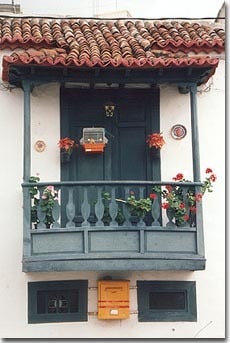
In the urban centre, hidden amongst banana plantations, buildings in traditional style mingle with modern architecture. Tazacorte has an abundance of old stately homes, narrow side streets and continuously flowering trees confused by an eternal spring.
The original town centre was in the neighbourhood of El Charco where the Monteverde family’s prosperous sugar mill was located. However, the surrounding areas soon began to expand with the growing number of employees from the mills, workshops, and other facilities.
The famous surnames of Monteverde, Vandale, Sotomayor, and Massieu were traditionally interlinked in marriage, thus ensuring the safekeeping of their estates for many centuries. These families lived in their ancestral homes, which kept within their walls the families’ shared past in the Netherlands. Of particular interest are Vizconde del Buen Paso palace, the stately home of Almirante Díaz Pimienta, the Massieu house, and that of the martyrs, all dating to the XVI century.
The percentage of the working class population dedicated to agriculture was always very high, and public recognition of this sector is reflected in the sculpture of the poor farmhand, located in front of the town hall.
Tazacorte is an Atlantic town overlooking an ocean horizon. At the foot of El Time, numerous bars and restaurants line the seashore where the smell of fried fish mixed with the fresh sea air creates a peaceful setting in this popular tourist spot.
The coast
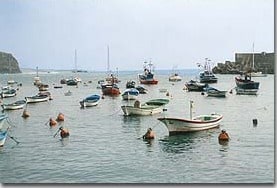
The port of this fishing village has always played an important role in the history of the island, and in the economy and development of the area. Nowadays it is a multi-purpose yet picturesque fishing port where multi-coloured boats, many of them yachts, pull in to the pier.
One of the most popular beaches is Playa del Roque with the El Time headland in the background, and the mouth of Barranco de Las Angustias, the outflow from the Caldera de Taburiente, to the north. This municipality also includes the Tenisca and Hondo ravines, which appear as old scars on the landscape.
Gentle landscapes are also found along the coast, rising up to the cliffs at the shores of the Atlantic, concealing beautiful black sand beaches like those of Los Guirres or Playa Nueva, which are tucked away from the trade winds. The lighthouse at Punta de Las Hoyas headland marks the border with Los Llanos at the coast and lights up the navigator’s path.
Geology
The plateau at the foot of the Valle de Aridane valley is broken up by the Barranco de Las Angustias ravine which has been declared a protected landscape. Year after year, the force of the water drags along streams of alluvial soil, expanding the size of the channel and eventually forming deposits along the coast.
The landscape of Tazacorte has been moulded by the lavas of the Tacande or Montaña Quemada volcano and the San Juan volcano. There are four volcanic cones next to one another, protected by the Law on Natural Areas (Ley de Espacios Naturales). Two of these, Todoque and La Laguna, stand out from the landscape with their coat of banana plantations.
Concealed below ground are unique volcanic tubes such as Los Caracoles in La Laguna, Cueva de Hércules or the better known Cueva del Perdido. The latter is 1,288 m in length, and is a complex intertwining labyrinth, with four mouths that open out along the cliffs of the municipality’s coast.
Copyright. Asociación para el Desarrollo Rural de la Isla de La Palma (ADER-La Palma).